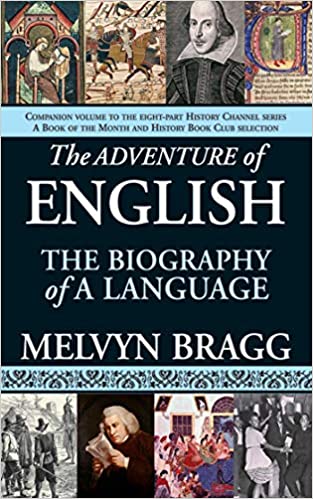
Review of The Adventure of the English Language by Melvyn Bragg
By: Michael A. Arnold

Imagine you had a time machine, would you rather go forward or backward in time? Suppose you wanted to go back, how far could you go before the English language you know simply stopped being understood by the people around you?
Language changes over time, and it is analogous with biological evolution. Linguistic evolution is the accumulation of hundreds of different trends or 'mutations' cumulating over a long time, and eventually these small changes combine into much bigger shifts in the way a language works. For example: speakers of French, Spanish and Italian find it easier to understand each other because all three have a 'common ancestor' in Latin. The same is actually true of Swedish and Norwegian speakers, both of which came from Norse. English, being on an island and so linguistically more isolated, is not mutually intelligible with other languages in quite this way. It is also extremely different from the other languages native to the British Isles, namely Welsh and Gaelic. This might be surprising, but English has a long and complicated history, one which is narrated in Melvyn Bragg's 2003 book The Adventure of English.
It might even be surprising to learn that English is not actually native to the British Isles. It was brought over from Germany and Denmark in around 500AD by warriors and settlers history remembers as 'the Anglo-Saxons'. The actual history of this period is pretty foggy. There are barely any archaeological records and basically no written record at all, but Bragg retells the generally accepted course of events, as well some of the popular stories, around how and why these peoples came to the British Isles and settled there. Eventually, when the history becomes more concrete, this 'Angle land' grew to become a large and powerful nation.
The language of the Anglo-Saxons, Old English, is very different from the language we speak today. Anyone who has read the original text of Beowulf knows that well enough. Between the rule of King Alfred of Wessex, in the second half of the 800s, and the Norman invasion in 1066, Bragg gives a rather interesting and basic idea of how this early version of English language was used. However, as soon as William the Conquer sets his feet down on the shore at Hastings, and subdues king Harold Godwinson, Bragg starts to anthropomorphise the English language in a more and more unusual way. 'England began raiding the word hordes of the oppressor French' he will say. It works as a metaphor once or twice, but with constant use it becomes slightly silly, making English sound like some kind of devious and brave freedom fighter – like a kind of linguistic William Wallace. It is clear that Bragg loves the English language, and this book was clearly a passion project, but it does linger in the 'Byronic anti-hero English Language' territory a little too much for its own good. At times the version of events can be a little questionable too.
An impression someone might get from this book is that the French kings were actively trying to supplant the English language between 1066 and 1184 (when Henry II came to power) but the plucky and rebellious English language fought back eventually won the war. This period of occupation by French nobility is why Anglo-Saxon words like 'Cow' and 'Sheep' turn into 'Beef' and 'Mutton' when the meat is cooked and served on a plate, because such food was often given to French Nobility who preferred their own vocabulary, which the English people just had to learn and adapt. There is no doubt some truth to this specifically, but there was never any actual danger that the English language would have ever gone extinct during this period like Bragg implies. French speakers were simply not settling in England in large enough numbers, and the average English person would have had no way to learn French even if they had wanted or needed to. The implication Bragg makes, though, is that French was an existential threat to the English language during this time, but then something strange happened. Eventually (according to this book) a fusion happened between the lower class English and the upper class French, creating a new language: Middle English - the English of Chaucer and the Canterbury Tales.
What this sets up, and which becomes persistent throughout the rest of the book, is an implication that the English language is somehow unique in world languages. The implied idea (only ever implied, never stated outright) is that English is somehow uniquely able to absorb new vocabulary and this is simply not true. Humans are as curious, inventive, and playful with language as they are with any other creative endeavour. French used to be the main lingua franca. Before that it was Latin. Currently it is English – and the reasons are not because they rank that way in their ability to adapt, but because of the power that people using those languages were able to command on the world stage. English became the dominant global language because the British Empire at one point covered one quarter of the earth's surface, and currently the major economic and military superpower is the United States - it would have been surprising if English had not become one of the most important and widely spoken languages on earth after all that.
However, despite criticisms against this book, it is honestly quite fun to read. It is, as the book suggests, an adventure, and it can be very informative. When it is not being overly romantic, it is giving a rough and interesting, if incomplete, history of the progression of English, and it does include sources and examples, so you can literally see the way English developed on the page. English started as a foreign language spoken by an invading army, and it is now something spoken by two billion people across the globe – that is a good story and Bragg does make it a lot of fun to read through. It is also quite a user-friendly book. It does not expect any specialist or linguistic knowledge from the reader, which is nice, however Bragg often finds the need to present sentences in Middle English untranslated – assuming anyone who reads the book will be able to understand what he's showing. This is quite brave as some are actually quite hard to read and fully decode – although you generally get the point, and so the larger point Bragg is making by including them.
This book is worth reading, but it is also a book worth questioning. it should not be considered authoritative – it is not.