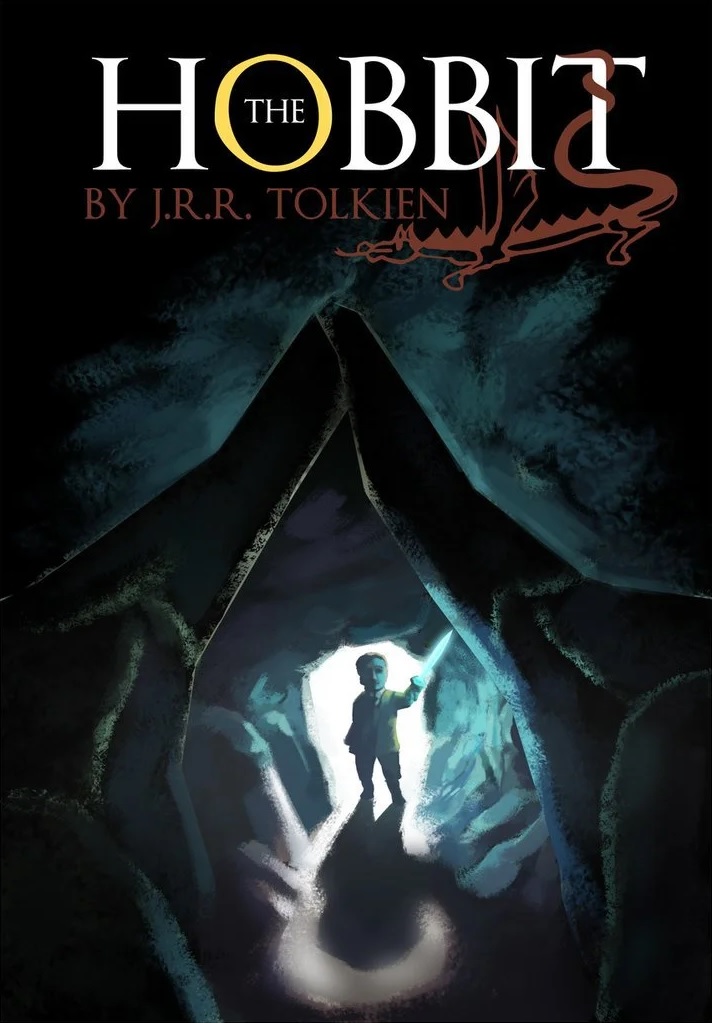
Review of The Hobbit by J. R. R. Tolkien
By: Michael A. Arnold

This is not a review of The Hobbit but another way of looking at it. Really, what can be said in a review of The Hobbit? It is the classic children's fantasy novel by J.R.R Tolkien that introduced his Middle Earth to the world. So, not much.
It is a book that has been talked about and written about (even academically) since it was first published by George Allen and Urwin in 1937. But one thing I do not see mentioned much is that it book is the work of a medievalist and scholar. One who held the position of the Rawlinson and Bosworth Professor of Anglo-Saxon, a widely respected and crucial head of Anglo-Saxon studies in Great Britain. What influence did Tolkien's position and academic interests have on The Hobbit?
A lot of the aesthetics of The Hobbit, and the wider Middle Earth legendarium, are inspired by Anglo-Saxon and Norse literature. The swords and shields, the prominence of mountains and the natural world, and even specific details seem to come from the places and mythologies of the frozen medieval north. Also, if you pick up a copy of The Hobbit and look at the title page you will see runes, and these dwarf runes (check this yourself) are different to the dwarf runes found in the 'Mines of Moria' section of The Lord of the Rings. There has not been a lot of comment on this, and it is a strange thing for Tolkien to do – to change an entire alphabet for his characters between books. While the runes in The Lord of the Rings are original to Tolkien, the runes in The Hobbit are not - they are Anglo-Saxon runes. If you had some free time, and a little careful thinking, you could probably teach yourself to read the majority of Anglo-Saxon runes just from the title page of The Hobbit. After this, checking the Wikipedia page on the runes will teach you the rest.
There is also the character of Beorn, 'Beorn' is an Anglo-Saxon word meaning man, who is a 'skin changer' – one who can change into a bear-like beast. Beorn lives in what appears (from both Tolkien's description and his own artwork found in most copies of the book) to be modeled on an Anglo-Saxon mead hall. The Beorn character is also a clear reference to the Saxon epic poem Beowulf. In the poem, Beowulf's fight with Grendel takes place in a hall much like Beorn's, and Beowulf's name comes from the two words 'beo wulf' – bee wolf' in modern English, an Anglo Saxon keening for a bear. A keening is a traditional Anglo-Saxon poety technique where two words are put together to symbolically suggest something else. For example, a 'bone house' is a body, the sea is a 'whale road', and a sword is an 'iron river'. Beowulf is symbolically a bear but he is also a man, a bit like Beorn.
But the influence from Beowulf goes much deeper than just these aesthetics and allusions, I would argue it goes to the very structure of the story. Some things are moved around, and changed and adapted but you could map the trials of Bilbo Baggins onto the trials of Beowulf.
Structurally the story of The Hobbit could be summed up something like this: Bilbo Baggins is called away from home because a group of people need help fighting a monster, on his journey he comes across his first great test with some trolls, and he finds he can overcome danger with a bit of courage and luck. Then after a rest and reward, Bilbo must go somewhere deep under the earth and face another challenge, but in beating this challenge finds a magical artifact that is (just in The Hobbit) unexplained but later helps him on his quest. Later he fights a dragon after someone steals gold from the dragon's lair and awakens it, and Biblo uses his magical artifact to help fight it. Eventually the dragon is killed by Bard, not one of the main heroes but someone introduced near the end of the story.
Change the names of the above and you would have a basically point by point breakdown of the story of Beowulf. Instead of ogres, Beowulf fights Grendel. Instead of a deep cave in a mountain, Beowulf faces Grendel's mother in a cave under a lake. Instead of some random person stealing from the dragon, it is Bilbo himself. Also, in The Hobbit the goal is to kill the dragon, while in Beowulf the dragon is only subtly alluded to in the beginning.
Obviously anyone who has read both stories might have issues with what I have just laid out. There are more things that happen to Bilbo along his journey to the Lonely Mountain than happen to Beowulf, but The Hobbit is a fun adventure with scares and thrills that was written, first for Tolkien's children, more or less episodically. But the plot points that vaguely correspond to Beowulf are also the most important for Bilbo's character arc. Other events and adventures in The Hobbit, such as Bilbo helping the Dwarfs to escape the elf city in Murkwood, or river that makes you forget things: they serve to show how Bilbo has adapted to the journey, rather than the events that adapt him to it.
Tolkien was probably not making any potential parallels with Beowulf intentionally; this was was just the way his imagination worked. He would take something he knew and then play around with it and change it – making something new. Super fans know about the island of Númenor, which was roughly based on the Atlantis story, for example. Tolkien was a recognized authority on Beowulf, he could read and write Old English more or less fluently, and Beowulf was by his own admission his favorite poem.
More important is what we can learn about these parallels, or echoes (if you prefer that). There is a lot to be said about how the things a writer likes filters unconsciously into their own work. It would be very hard to be completely original, and that was not what Tolkien was necessarily concerned with. His legendarium was full of references, images and inspiration from the things that he loved and inspired him – but what he did was reinvent them. We can, as writers, use old ideas in new ways, and give them new life. Or make them into something new. For Tolkien it was medieval mythology and literature that helped him create a book as memorable as The Hobbit, and a world as memorable as Middle Earth.